
Calcium carbonate (CaCO₃) is one of the world’s most widely used industrial minerals — inexpensive, abundant, and highly versatile. Whether it’s improving paint opacity, acting as a filler in plastics, buffering soil in agriculture, or serving as a pharmaceutical excipient, different grades and particle shapes of calcium carbonate make it possible to tune performance for specific applications. This guide explains the main types of calcium carbonate, how they’re graded, and where each grade shines — with practical pointers for buyers and specifiers.
What is calcium carbonate (quick primer)?
At the molecular level calcium carbonate is a simple salt (CaCO₃). Industrially it comes in two broad families:
- Ground (or natural) calcium carbonate — GCC: mechanically milled from sources such as limestone, marble and chalk. GCC’s properties depend on the mineral source and grinding fineness.
- Precipitated calcium carbonate — PCC: synthetically produced through controlled chemical precipitation. PCC allows tighter control of particle size, shape (rhombohedral, scalenohedral, etc.), surface area and purity, which delivers improved optical and rheological performance in demanding applications.
Understanding whether GCC or PCC (or a coated/activated variant) is best for your use-case is the first step to specifying the right product.
Common grades and how they differ
Calcium carbonate is classified by several overlapping attributes:
1. Purity / whiteness — Food-grade and pharma-grade calcium carbonate require the highest purity and whiteness; industrial grades (for construction, basic fillers) accept lower purity.
2. Particle size / fineness (mesh / microns) — Coarser grades (hundreds of microns) are used in construction or agriculture; fine micronized grades (sub-10 μm) and nano-forms are used in coatings, high-gloss papers and speciality plastics. Particle size dictates opacity, surface area, and dispersion behavior.
3. Surface treatment / coating — Many manufacturers offer coated calcium carbonate (e.g., stearic acid or silane coatings) to improve compatibility with polymers, reduce oil absorption, or modify flow properties for concentrates and masterbatches. Sukesh Industries lists coated and activated variants tailored to PVC, paint and masterbatch customers.
4. Shape and morphology (for PCC) — PCC particle shape can be engineered to enhance gloss, opacity and rheology in paints and paper coatings. This is a key advantage of PCC versus GCC.
Principal industry applications (and which grade to choose)
Paints & coatings
Calcium carbonate is a primary extender and matting agent in decorative and industrial paints. Fine, high-whiteness GCC and PCC improve opacity, hiding power and rheology; coated grades prevent pigment settling and improve dispersion in polymer emulsions. PCC is preferred for high-gloss, high-whiteness coatings while ground calcium carbonate is cost-effective for matt and interior formulations.
Paper industry
Paper uses calcium carbonate as a filler (inside the paper body) and a coating pigment. PCC, with controlled particle size and narrow distribution, gives better brightness and gloss in coated papers; GCC is commonly used as a bulk, lower-cost filler in newsprint and many grades of writing paper. The move toward alkaline papermaking has also increased CaCO₃ use because of its chemical compatibility.
Plastics and PVC
As a filler, calcium carbonate reduces material cost, improves stiffness and dimensional stability, and can help thermal properties. For PVC flooring, rigid PVC profiles and masterbatches, coated GCC with controlled particle size is commonly used. PCC sometimes improves surface finish and dispersion where appearance matters.
Rubber and adhesives
Calcium carbonate enhances tensile properties and hardness in many elastomer formulations; surface-treated grades increase compatibility with organic rubbers. PCC’s controlled morphology is useful where consistency and surface appearance are important.
Pharmaceuticals & food
Food-grade and pharma-grade calcium carbonate are used as antacids, calcium supplements, and as inert tablet fillers. These applications demand rigorous impurity control, traceability and compliance with pharmacopeia/food safety standards — typically a high-purity PCC or specially processed GCC. Always request certificates of analysis and regulatory compliance documentation for these grades.
Construction, cement and lime
Crushed limestone and lime (derived from calcining CaCO₃) remain critical in cement, mortar, soil stabilization and road base. Coarser limestone products and hydrated lime powders from suppliers such as Sukesh Industries are widely used in these sectors.
Agriculture and aquaculture
Finely ground calcium carbonate (agricultural lime, calcite) is used to neutralize acidic soils and improve crop yields; dolomite (contains MgCO₃) supplies magnesium as well as calcium for soil correction. In aquaculture, carbonate powders help buffer pond pH and improve water hardness.
Specialized uses: drilling, glass, toothpaste, and more
Calcium carbonate is used as a weighting agent and bridging material in drilling fluids, as a raw material in certain glass and ceramic formulations, and as an abrasive/polishing and thickening agent in toothpaste and cleaning powders. Its low cost and tunable physical traits make it attractive across many niche applications.
How to specify calcium carbonate for procurement (practical checklist)
When you’re buying CaCO₃, specify the following to avoid surprises:
- Formulation / Type: GCC or PCC (or coated/activated). Specify if you need natural vs precipitated.
- Purity / Loss on Ignition / Residue: Provide acceptable ranges. Higher-purity applications (food, pharma, paper) need stricter specs.
- Particle size distribution: Give D50, D90 and mesh equivalents if applicable. Surface area (m²/g) is useful for fine grades.
- Whiteness / Brightness: Important for paints and paper. Request test method.
- Moisture & Oil Absorption: Affect storage, mixing and formulation. Ask for manufacturer test data.
- Surface treatment: If you need coated particles (e.g., for polymer compatibility), specify the coating and target performance.
- Regulatory certificates: For food, pharma or cosmetic use request relevant certificates and COA.
Value-added services and customizations
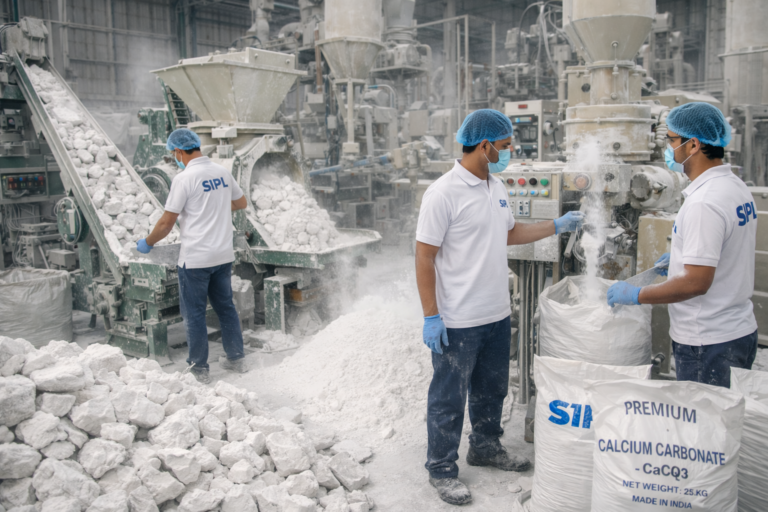
Suppliers like Sukesh Industries offer several value adds: tailored milling to a target micron size, surface coatings, custom packaging (50 kg HDPE or PP bags), and bulk logistics for large industrial orders. They typically publish product data pages for paint grade, paper grade, activated and coated calcium carbonate — handy when comparing offers and performing incoming quality checks.
Common pitfalls and how to avoid them
- Mismatched specs: Buying a generic GCC for a high-gloss coating will underperform. Match grade to end-use.
- Ignoring particle distribution: Two powders with the same D50 can behave very differently if one has a broad distribution and the other is narrow. Ask for full PSD.
- Skipping compatibility tests: In polymers and paints, small changes in surface chemistry alter dispersibility — run trial batches.
Sustainability & circularity notes
Calcium carbonate is naturally abundant and often locally sourced, which reduces transport emissions compared with exotic fillers. Newer processes and optimization in grinding and precipitation are improving energy efficiency. When sustainability is a priority, request supplier data on sourcing, energy use and packaging recyclability.
Final thoughts — which grade should you start with
- For cost-sensitive bulk applications (construction, basic filled plastics): start with a GCC matched to the particle size and purity you need.
- For performance applications demanding whiteness, gloss or narrow PSD (coatings, high-grade paper, specialty plastics): evaluate PCC or coated PCC.
- For regulatory uses (food, pharma): insist on certified food/pharma grade with full COA and traceability.